RETROBAT

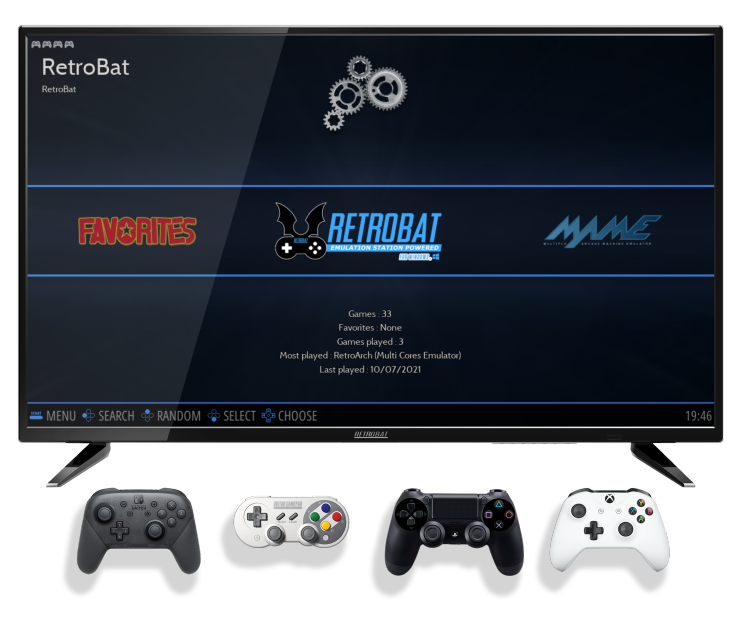
RetroBat is a software distribution designed for emulation and to be the easiest way to enjoy your game collection on your Windows computer. The supplied EmulationStation interface is fully functional and highly customizable. You can run all your games from it and search online for visuals to enhance the presentation of your collection.

RetroBat allows you to download, update and configure the most renowned emulators directly from the interface. You will discover or rediscover the best games designed for consoles, arcades and computers released to date.

No need to get lost in the options of a multitude of software, all the important options are integrated in the same unified interface.

With RetroBat, you save time that you can use to play!
tv RB 1
windows 1
open source
emulstation 1
retroarch

Minimum requirements

To work properly, the following requirements must be met.

OS :
Windows 8.1 64 Bits, Windows 10 64 Bits, Windows 11 64 Bits

Processor :
CPU with SSE2 support. 3 GHz and Dual Core, not older than 2008 is highly recommended.

Graphics :
– If you want to use emulators such as Dolphin, PCSX2, RPCS3 etc.. you need a modern graphics card that supports Direct3D 11.1 / OpenGL 4.4 / Vulkan

Software :
– VC++ Redistributables (both 32 & 64 bits)
– DirectX

Pad :
You need one or more pads (See recommended controllers)

At the heart of Lang’s design method is . He views an origami subject (like an insect or animal) as a "tree" of points and edges—essentially a stick figure where each branch represents a part like a leg, wing, or tail.

Lang's use of mathematical concepts, such as tessellations, fractals, and graph theory, allows him to create origami models that are both visually striking and structurally sound. His designs often feature intricate patterns, symmetries, and tessellations, which are achieved through a deep understanding of the mathematical principles that underlie the art of origami.

Lang introduces several systematic methods to translate these abstract "trees" into foldable crease patterns:

Beyond theory, the book offers step-by-step projects that progress from simple geometric folds to astonishing multi-legged insects and human figures. Each project teaches a specific design principle, allowing readers to eventually invent their own original models.

Origami Design Secrets - Robert Lang

At the heart of Lang’s design method is . He views an origami subject (like an insect or animal) as a "tree" of points and edges—essentially a stick figure where each branch represents a part like a leg, wing, or tail.

Lang's use of mathematical concepts, such as tessellations, fractals, and graph theory, allows him to create origami models that are both visually striking and structurally sound. His designs often feature intricate patterns, symmetries, and tessellations, which are achieved through a deep understanding of the mathematical principles that underlie the art of origami. origami design secrets robert lang

Lang introduces several systematic methods to translate these abstract "trees" into foldable crease patterns: At the heart of Lang’s design method is

Beyond theory, the book offers step-by-step projects that progress from simple geometric folds to astonishing multi-legged insects and human figures. Each project teaches a specific design principle, allowing readers to eventually invent their own original models. His designs often feature intricate patterns