Hot Upd — Mscz To Midi Online Converter
All About Digital Photos

Hot Upd — Mscz To Midi Online Converter

Solid post: "MSCZ to MIDI Online Converter — Fast, Easy, Free" Need to convert MuseScore (.mscz) files to MIDI quickly? Here’s a concise, shareable post you can use on social media, a forum, or a blog. Quick headline MSCZ to MIDI Online Converter — Fast, Easy, Free Punchy opening (1 line) Convert MuseScore files (.mscz) to MIDI in seconds — no software install, just drag, convert, download. Key features (bullet list)

Fast: upload and convert in seconds. Simple: one-step conversion — choose file, click Convert, download MIDI. Accurate: preserves notation playback, tempo, and instrumentation for reliable MIDI output. Free & no account: convert single files without signing up. Cross-platform: works in any modern browser on desktop or mobile. Privacy-minded: files are processed and removed after conversion (confirm on the site).

How to use (3 quick steps)

Open the converter site and click “Upload” (or drag your .mscz file). Click “Convert to MIDI.” Download the .mid file and import into your DAW or sequencer. mscz to midi online converter hot

When to use it (short list)

Export MuseScore arrangements to a DAW for production. Create backing tracks or practice files. Extract MIDI for editing, tempo mapping, or notation import into other software.

Quick tips for best results

Export from MuseScore with full instruments and playback settings saved. If the converter misinterprets articulations or dynamics, check the exported MIDI in a DAW and remap tracks/instruments. For multi-part scores, verify lane/track assignments after import.

CTA (1 line) Try it now — convert your .mscz to MIDI and take your score straight into your DAW. Suggested hashtags #musescore #MIDI #musicproduction #DAW #sheetmusic #convert Related search suggestions (you can use these to find converters, tutorials, or tools)

"mscz to midi converter online" (0.9) "convert MuseScore to MIDI" (0.85) "export mscz as midi MuseScore" (0.8) Solid post: "MSCZ to MIDI Online Converter —

Converting files (the default format for is a common task for musicians who want to move their sheet music into a DAW (like Ableton or FL Studio) for production. While many "online converters" often focus on converting audio (like MP3) to MIDI, converting a notation file like requires specific handling. Here is an article outlining the best ways to handle this in 2025. Converting MSCZ to MIDI: The Best Online & Offline Methods 1. The "Golden Standard": MuseScore’s Native Export The most reliable way to convert an file to MIDI is by using the software that created it. Since MuseScore is free and open-source, this remains the "hottest" and most accurate method. How to do it: Open your file in MuseScore, go to File > Export , and select Standard MIDI File (.mid) from the dropdown menu. Why it’s best: Unlike AI-based audio converters, this method preserves every note, velocity, and timing perfectly because it’s a direct data export rather than a "guess" based on sound. 2. The Best "No-Install" Method: MuseScore.com If you don't want to install software, you can use the MuseScore Cloud How to do it: Upload your MuseScore.com (you’ll need a free account). Once uploaded, use the button on the score page and select Quick conversions when you're on a Chromebook or a public computer. 3. Online Multi-Format Converters There are several third-party sites that claim to handle MuseScore files. However, use caution as some are actually "Audio to MIDI" converters that might require you to convert your to an MP3 first. FreeConvert A versatile tool that supports hundreds of formats. While it primarily handles existing MIDI files, it's a "go-to" for general file transitions. Deep Signal Studios A specialized service for users who have old or complex MuseScore files and need professional conversion to MIDI or other notation formats. 4. Alternative: Audio-to-MIDI (AI Conversion) If you only have a recording of your MuseScore piece (MP3/WAV) and lost the original file, you can use AI tools to "reconstruct" the MIDI: Spotify Basic Pitch An excellent, free AI tool that transcribes audio into MIDI directly in your browser. Another high-quality AI tool for converting audio stems into MIDI. MIDI import - MuseScore

Converting MSCZ (MuseScore) files to MIDI online is a specialized process because MSCZ is a compressed XML-based format unique to the MuseScore notation software . While standard audio-to-MIDI converters exist, they often cannot parse the complex notation data inside an MSCZ file.   Core Conversion Features   A robust online MSCZ to MIDI converter should offer these key features:   Native File Parsing: Support for both .mscz and the uncompressed .mscx formats. Multi-Track Preservation: Ensures that individual instrument parts (piano, violin, drums) are converted into separate MIDI tracks rather than a single merged stream. Dynamic Expression Mapping: Converts notation markers like crescendos, sforzandos, and articulations into MIDI velocity and CC (Continuous Controller) data. Tempo & Signature Sync: Automatically extracts and applies the original score’s tempo changes and time signatures to the MIDI file. Batch Conversion: Allows users to upload multiple scores at once to save time.   Top Conversion Methods   MIDI Converter - FreeConvert.com How to Convert a MIDI file? Click the “Choose Files” button to select your MIDI files. Then select a target format and click the " FreeConvert MIDI import - MuseScore

 
Changing the DPI

DPI vs PPI - please note that references here to DPI (Dots Per Inch) actually means PPI (Pixels Per Inch). I continue to use DPI since that's still how many people (incorrectly) understand it. And with some software (i.e. most scanning software), you'll still see DPI used where PPI is what is actually meant. DPI (meaning printer dots per inch) is essentially an obsolete term. But it's still in very common use as a term to mean PPI. See What is DPI. At some point I'll change all my DPIs to PPIs - but that's another project for another day :-)


If you've come here after reading my article "The Myth of DPI" you'll already know that DPI has nothing to do with digital image resolution or quality. However, some people and places who are still ignorant of that fact (many graphics designers, magazines and print shops) still insist of getting a photo with an internal setting of ___DPI (usually 300 DPI) even when the photo's pixel resolution is sufficient to print the photo at the required PPI. The easy solution (rather than trying to educate them about real digital photo resolution) is to simply change the DPI setting of your image to whatever they want and send it along to them.

You may also wish to change the DPI so that the image will default size to the intended print dimensions when loaded into a word processor or desk top publishing program. For instance, if you want to set a 1500 pixel wide photo so that it will default to a 4 inch print dimension, then change the DPI setting of the photo to 375 DPI (1500 pixels divided by 4 inches = 375 pixels per inch).

The trick when changing the DPI is to do it without resizing (resampling) your image in the process. You want to change the DPI while retaining the original pixel dimensions (the real digital resolution) of the photo. I'll provide three examples, one using Adobe Photoshop (Windows & mac) and the other two using the free programs XnView (Windows, Linux & mac) and Irfanview (Windows).

Note that this procedure will not change the digital photo in any way other than to alter the internal DPI setting. The size and resolution of the digital image will be unchanged.

XnView Method
    mscz to midi online converter hot
    note that the "Resample Image" box is UNCHECKED and that the "Print Size" has been set to 300
  1. Open a folder with images and select an image to show full view.
  2. Select the "Image > Resize" menu option (not the "set DPI" option)
  3. In the image size dialog window, deselect the "Resample Image" checkbox (make sure there is no checkmark in that box).
  4. In the "Resolution" box type in 300 (or whatever DPI you want)
  5. Click the "OK" button
  6. Your image DPI has now been set to whatever you want (leaving the pixel dimensions of the image unchanged).
  7. Save this photo with a new name - I suggest adding a -300dpi extender (i.e. "345-2365-300dpi.jpg") to identify this new DPI image.
  8. See note below when saving to JPEG format
Earlier versions of XnView had a bug in which the DPI change wasn't recognized by programs such as Adobe Photoshop. This was fixed in 2009, so any current version is fine. There is a direct "set DPI" option, but you have to make sure to adjust both the X and Y to identical values (only the X value will be recognized by Photoshop, I'm not sure what happens with the Y, hence best to stick with the "Resize" dialog).
Adobe Photoshop Method
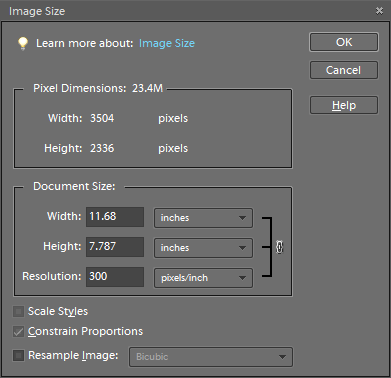
    adobe - change dpi
    note that the "Resample Image" box is UNCHECKED
    and that the "Resolution" has been set to 300
  1. Load your image into Adobe Photoshop (or Photoshop Elements).
  2. Select the "Image > Image Size" menu option (may be "Image > Resize > Image Size" in Photoshop Elements).
  3. In the image size dialog window, deselect the "Resample Image" checkbox (make sure there is no checkmark in that box).
  4. In the "Resolution" box type in 300 (or whatever DPI you want)
  5. Click the "OK" button
  6. Your image DPI has now been set to whatever you want (leaving the pixel dimensions of the image unchanged).
  7. Save this photo with a new name - I suggest adding a -300dpi extender (i.e. "345-2365-300dpi.jpg") to identify this new DPI image.
  8. See note below when saving to JPEG format

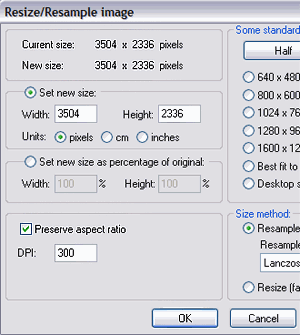
Irfanview Resize Image Dialog Box
Irfanview Method
  1. Load your image into Irfanview
  2. Select the "Image > Resize/Resample" option
  3. In that dialog window you'll see a specific DPI data box
  4. Simply enter whatever DPI you want without adjusting anything else in that dialog window.
  5. Click on the "OK" button
  6. Your image DPI has now been set to whatever you want (leaving the pixel dimensions of the image unchanged).
  7. Use "Save As" to save this photo with a new name - I suggest adding a -300dpi extender (i.e. "345-2365-300dpi.jpg") to identify this new DPI image.
  8. See note below when saving to JPEG format

Saving to JPEG - please note that JPEG is a digital photo format that uses variable compression - that is, you can change the compression. Your camera should (if you have it set correctly) be using low compression (highest quality). To emulate this when doing a "save as" from a photo program, choose a compression of about 95 (Adobe Quality 10+).

If you are using XnView, when you do a JPEG save, click on the "Options" button to give you the JPEG save dialog and move the slide towards "Best" to whatever number (i.e. 95) you wish. Using Irfanview, when you do a "Save As" in JPEG format, note the dialog box with the JPEG options - move the slider to 95 (or higher if you wish) for best image quality. With Adobe Photoshop (incl. Elements) - choose quality 10 or higher in the dialog box that comes up when you do a Save As in JPEG format.

A verification is to check the image filesize (in kilobytes or megabytes) of your copy of the photo against the original digital photo. They probably won't be identical, but should be close. If there is a big discrepancy in filesize then you've done something wrong.

Other Programs

Other photo programs are going to have a similar process. The key is to make sure that the image IS NOT being resampled (pixel resized) when the DPI is changed. As long as the pixel dimensions remain unchanged, your new DPI photo will be identical to your original photo, only the internal DPI setting of the photo will have been changed. Your print shop, graphics designer or magazine should be happy campers with your "new higher DPI" image.


Home   •   What Is | Filetypes | Colour Models | Acronyms and Nomenclature | Frequently Asked Questions (FAQ)   •   Storage   •   Digital Labelling | Visible Captioning   •   What Is DPI | Myth DPI | Change DPI   •   Changing Size   •   Print Shops | Arithmetic of DPI | FAQ | Photoshop Dialog Box   •   Home Printing | Print Shops   •   Geotagging   •   Scanning   •   Digital Images and Genealogy | Make Your Photos Last Forever | Camera or Scanner | Copying Old Photos | Workflow Examples | Visible Captioning | Choosing a Camera | Print Longevity | Sending Photos to Relatives

Comments: send me email:

URL: www.rideau-info.com/photos/changedpi.html
© 2003- Ken W. Watson