


Digital Processing Of Synthetic Aperture Radar Data Pdf //free\\

Since its creation in 1997, elBullitaller’s aim has been to expand the range of textures that can be used in the kitchen. As a result of this research, techniques such as foams, clouds, etc. have been created, representing an evolution in his style.
The Texturas range is essential if you want to incorporate some of our most famous techniques into your kitchen, such as hot jellies, air, gelatine caviar or spherical ravioli.
The products that make up the five families – Spherification, Gelification, Emulsification, Thickeners and Surprises – are the result of a rigorous selection and testing process. Texturas is the beginning of a world of magical sensations that has expanded over the years.
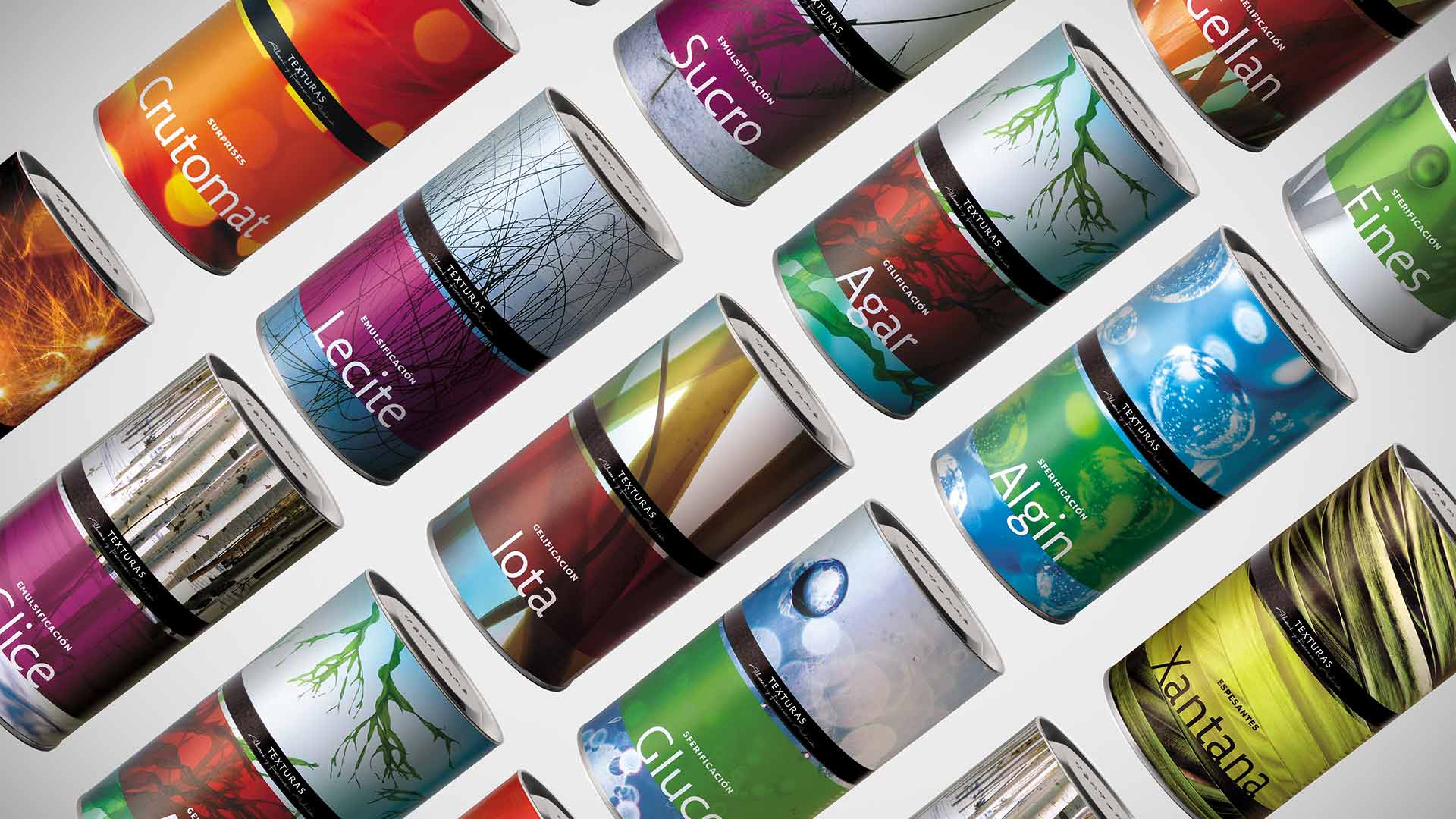
SFERIFICATION
Spherification is a spectacular culinary technique, introduced at elBulli in 2003, that allows you to create recipes never before imagined. It is the controlled gelling of a liquid which, when immersed in a bath, forms spheres. There are two types: Basic Spherification (which consists of immersing a liquid with algin in a calcic bath) and Reverse Spherification (immersing a liquid with gluco in an algin bath). These techniques make it possible to obtain spheres of different sizes: caviar, eggs, gnocchi, ravioli… In both techniques, the spheres obtained can be manipulated as they are slightly flexible. We can introduce solid elements into the spheres, which remain suspended in the liquid, thus obtaining two or more flavours in one preparation. In basic spherification, some ingredients require the use of citrus to correct the acidity; in reverse spherification, xanthan is usually used to thicken. Spherification requires the use of specific tools, which are included in the kits.
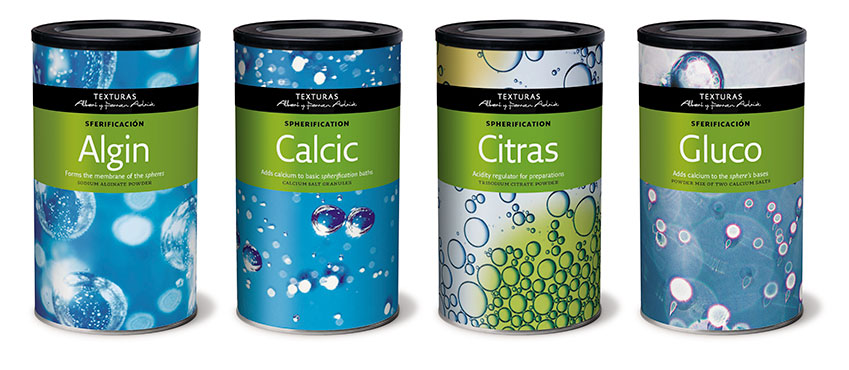
GELLING
Jellies are one of the most characteristic preparations of classical cuisine and have evolved with modern cuisine. Until a few years ago, they were mainly made with gelatin sheets (known as “fish tails”); since 1997, agar, a derivative of seaweed, has been used.
The kappa and iota carrageenans are also obtained from seaweed and have specific properties of elasticity and firmness that give them their own personality.
To complete the family, we present gellan, which makes it possible to obtain a rigid and firm gel, and methyl, with high gelling power and great reliability.
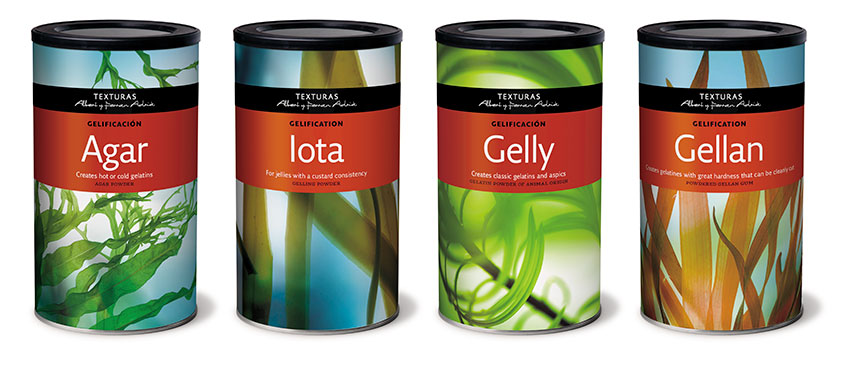
EMULSIFICATION
The Lecite product, which is used to make aerated preparations, has been joined by two other products, Sucro and Glice. The main feature of the latter is its ability to combine two phases that cannot be mixed, such as fatty and aqueous media. This makes it possible to create emulsions that would otherwise be very difficult to achieve.
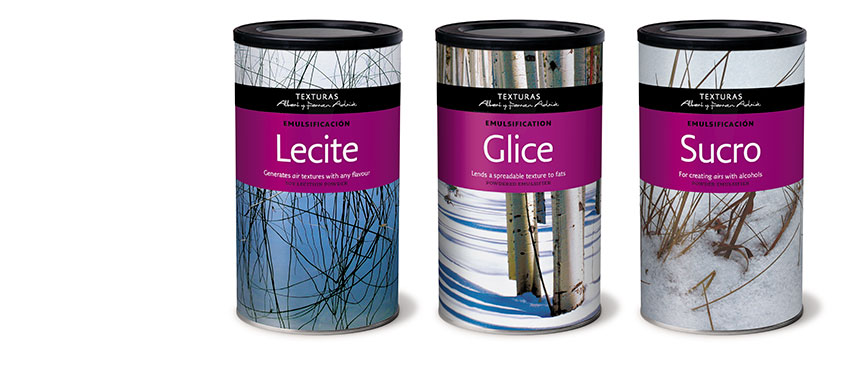
THICKENERS
Products have always been used in the kitchen to thicken sauces, creams, juices, soups, etc. Starch, cornstarch, flour are the traditional thickeners used, with the disadvantage that a significant amount has to be added, which affects the final flavour.
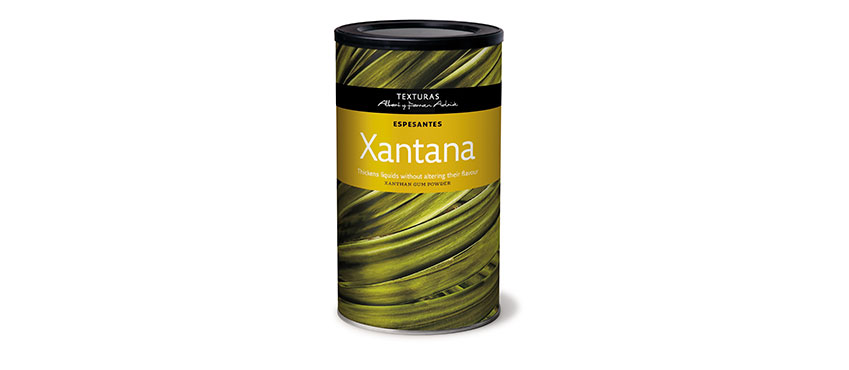
With the Xantana family of thickeners, we present a new product capable of thickening cooking preparations with a minimum quantity and without altering the initial flavour characteristics in any way.
SURPRISES
It is a line of products whose main characteristic is the possibility of consuming them directly, either on their own or mixed with other ingredients and preparations.
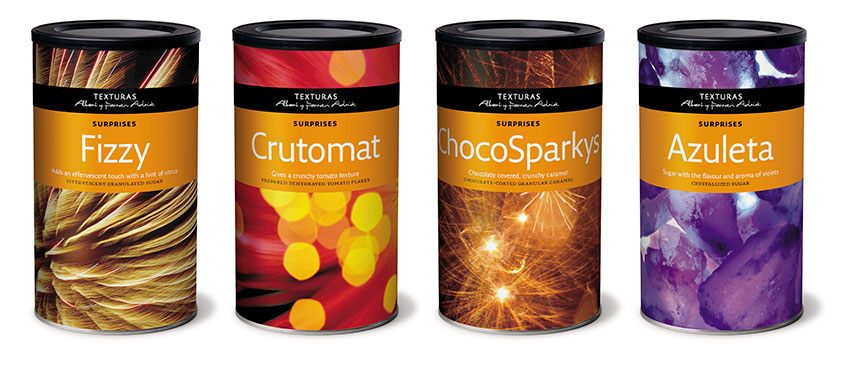
These are products with different characteristics, but with a common denominator, their special texture, specific and unique to each of them, effervescent in the case of Fizzy, Malto and Yopol, and crunchy in Crumiel, Trisol and Crutomat. Flavours and textures that can be a fantastic and surprising solution for refining both sweet and savoury recipes.
OTHER PRODUCTS
Des de la seva creació el 1997, a elBullitaller es va marcar el propòsit d’ampliar el ventall de textures possibles a la cuina. Fruit d’aquestes investigacions van néixer tècniques que, com ara les escumes, els núvols, etc., han representat una evolució en el seu estil.
La línia de productes de Textures, és imprescindible per poder incorporar a la teva cuina algunes de les nostres tècniques més conegudes, com ara les gelatines calentes, els aires, els caviars de gelatina o els raviolis sfèrics.
Els productes que integren les cinc famílies Sferificació, Gelificació, Emulsificació, Espessants i Surprises, són el resultat d’un rigorós procés de selecció i assaigs. Textures representa l´inici d´un món de sensacions màgiques que durant els anys s´ha anat ampliant.
SFERIFICACIÓN
La Sferificació és una tècnica culinària espectacular que es va posar en pràctica a elBulli el 2003 i que permet elaborar unes receptes mai abans imaginades. Es tracta de la gelificació controlada d’un líquid que submergit en un bany forma esferes. Hi ha dos tipus: la Sferificació Bàsica (que consisteix a submergir un líquid amb Algin en un bany de Calcic) i la Sferificació Inversa (submergir un líquid amb Gluco en un bany d’Algin). Aquestes tècniques permeten obtenir esferes de diferents mides: caviar, ous, nyoquis, raviolis… En ambdues tècniques, les sferes resultants es poden manipular, ja que són lleugerament flexibles. Podem introduir elements sòlids dins de les sferes, que quedaran en suspensió al líquid, de manera que s’aconsegueixen dos sabors o més en una elaboració. A la Sferificació Bàsica, amb alguns ingredients cal emprar Citres per corregir l’acidesa; a la Sferificació Inversa, se sol emprar Xantana per espessir. La Sferificació requereix l’ús d’utensilis específics (Eines), que s’inclouen als Kits corresponents.
GELIFICACIÓ
Les gelatines són una de les elaboracions més característiques de la cuina clàssica, i que amb la cuina moderna han experimentat una evolució més gran. Fins fa uns anys s’obtenien principalment amb fulles de gelatina (conegudes com a “cues de peix”); a partir del 1997 s’hi va incorporar l’Agar, un derivat de les algues que avui dia ja és d’ús comú.
Els carragenats Kappa i Iota també s’obtenen a partir d’algues i presenten característiques particulars d’elasticitat i fermesa, que els atorguen personalitat pròpia.
Per completar la família presentem Gellan, que permet obtenir un gel rígid i ferm; i Metil, d’alt poder gelificant i de gran fiabilitat.
EMULSIFICACIÓ
Família que va néixer amb el producte Lecite, amb què es poden obtenir elaboracions airejades, ia la qual s’han afegit dos productes més, Sucro i Glice. La característica més destacable d’aquests darrers és la capacitat d’unir dues fases que no es poden barrejar, com són els medis grassos i els mitjans aquosos. Això permet fer emulsions que altrament seria molt difícil aconseguir.
ESPESSANTS
A la cuina s’han utilitzat des de sempre productes per espessir salses, cremes, sucs, sopes, etc. Els midons, les fècules, la farina, són els espessidors que s’han emprat tradicionalment, amb l’inconvenient que cal afegir una quantitat notable, cosa que incideix en el sabor final.
Amb la família Espesantes presentem Xantana, un nou producte capaç d’espessir les elaboracions de cuina amb una quantitat mínima, i sense distorsionar en absolut les característiques gustatives inicials.
SURPRISES
És una línia de productes la principal peculiaritat dels quals és la possibilitat de consumir-los directament, ja sigui sols o bé barrejats amb altres ingredients i elaboracions.
Es tracta de productes de característiques diferents entre si, però amb un denominador comú, la seva especial textura, particular i única de cadascun, efervescent en el cas de Fizzy, lleugera a Malto i Yopol, i cruixent a Crumiel, Trisol i Crutomat . Sabors i textures que poden representar una solució fantàstica i sorprenent per a l’acabat de receptes tant dolces com salades.
OTROS PRODUCTOS
The year was 2048, and the world was perpetually veiled. A series of atmospheric shifts had left the planet under a thick, unending blanket of "Iron Nebula" clouds—impenetrable to standard optics and human eyes. Elias sat in the dim glow of the Orbital Processing Hub, staring at a screen of raw, chaotic noise. To anyone else, it looked like static on an old television. To him, it was a mathematical puzzle waiting to be solved. He was an "Echo Weaver," a specialist in the Digital Processing of Synthetic Aperture Radar (SAR) Data . "The visual drones are blind again," a voice crackled over the comms. It was Commander Vane, grounded at the edge of the Amazon Basin. "We need to find the relief cache before the flood hits, Elias. Can you see through this soup?" Elias pulled up a weathered digital PDF—a relic from the early 2000s titled Digital Processing of Synthetic Aperture Radar Data . Its pages were filled with complex algorithms: Range-Doppler , Chirp Scaling , and Speckle Reduction . While AI handled the basics, the "Iron Nebula" required a human touch to tune the matched filters. "Stand by," Elias muttered, his fingers dancing across the haptic interface. He initiated the Pulse Compression . In his mind, he visualized the satellite sweeping across the jungle floor, emitting microwave pulses that bounced off canopy and metal alike. The raw data flowed in—a massive, complex-valued matrix. The Range Migration: He watched the echoes shift. Because the satellite was moving at thousands of miles per hour, the targets appeared to "walk" across the sensor's memory. He applied the Range Cell Migration Correction (RCMC) , pulling the blurred streaks back into sharp, vertical alignments. The Azimuth Focus: This was the magic of SAR. By mathematically simulating a massive antenna—miles long—he synthesized a resolution that shouldn't exist. He tuned the Doppler Centroid , filtering out the noise of the swirling storm. The Final Render: He ran a final Speckle Filter to smooth out the grainy "salt and pepper" noise that plagued radar imagery. Slowly, the static on his screen began to coalesce. The chaotic grays shifted into sharp, silver outlines. The jagged edges of the forest appeared, and there, nestled in a ravine, was the unmistakable geometric signature of the relief crate. "I have it," Elias said, his voice steady. "Coordinate 04-22-Alpha. It’s 50 meters east of the riverbend. And Vane? Watch out. The SAR is picking up a secondary return—the bridge is washed out. You’ll have to take the ridge." "Copy that, Weaver," Vane replied, relief evident in his tone. "Thanks for the eyes." Elias closed the PDF, the ghost of the old mathematicians smiling back at him from the equations. In a world that had gone dark, the echoes were the only truth left.
Digital Processing of Synthetic Aperture Radar Data: Algorithms and Implementation Digital processing of Synthetic Aperture Radar (SAR) data is the computational cornerstone of modern remote sensing, transforming raw microwave echoes into high-resolution imagery . Unlike optical sensors that capture a single "snapshot," SAR systems use the movement of the platform (satellite or aircraft) to "synthesize" a massive virtual antenna, allowing for fine spatial resolution regardless of the sensor's physical size. For professionals and students seeking a comprehensive technical foundation, the Digital Processing of Synthetic Aperture Radar Data by Ian G. Cumming and Frank H. Wong is widely considered the definitive authority on SAR signal processing . 1. The Core Objective: Image Formation The primary goal of SAR processing is image formation —converting "raw" signal data (phase history) into a focused Single-Look Complex (SLC) image . The process is divided into two main dimensions: Synthetic Aperture Radar (SAR) - NASA Earthdata
Here’s a review of the book Digital Processing of Synthetic Aperture Radar Data: Algorithms and Implementation by Ian G. Cumming and Frank H. Wong, assuming you’re referring to the PDF version commonly used in remote sensing and radar signal processing courses.
Title: The SAR Practitioner’s Bible – Dense but Indispensable Rating: ★★★★☆ (4.5/5) If you work with Synthetic Aperture Radar (SAR) data and have ever felt lost between theoretical papers and actual focusing code, this book is the bridge you need. The PDF version has become a quiet standard on desks (and hard drives) of radar engineers, geophysicists, and remote sensing scientists. What’s Great: The book’s strength is its unwavering focus on algorithms . It walks through the major focusing techniques—Range-Doppler (RD), Chirp Scaling (CS), Range Migration Algorithm (RMA), and SPECAN—with exceptional clarity. Each algorithm is presented with a step-by-step block diagram, the key equations (without excessive derivation clutter), and, crucially, practical considerations like phase preservation, interpolation, and azimuth compression. The Matlab-style pseudo-code snippets are worth their weight in gold for anyone implementing a processor from scratch. Chapters on secondary compression (e.g., ScanSAR, polarimetry) add real-world utility. PDF-Specific Pros: digital processing of synthetic aperture radar data pdf
Fully searchable – a lifesaver for finding “azimuth ambiguity” or “Stolt interpolation” quickly. Diagrams and FFT shift illustrations are crisp in digital format. No lugging around a 600-page hardcover.
The Catch: This is not a beginner’s first radar book. The authors assume you know what range and azimuth mean, understand FFT properties, and have seen a matched filter before. Newcomers may find the first two chapters terse. Also, the PDF version lacks any interactive code (you’ll need to transcribe the pseudo-code manually), and some of the notation feels dated (e.g., using ( \tau ) and ( \eta ) for fast/slow time takes getting used to). Missing in the PDF? Occasionally, figures referenced in the text appear slightly low-resolution in scanned copies – check you have an original typeset PDF, not a grayscale scan. Also, there’s no companion website or downloadable code, unlike modern textbooks. Verdict: For anyone serious about SAR processing – whether you’re debugging a Range-Doppler processor, learning Chirp Scaling for Sentinel-1 data, or prepping for a radar engineering role – this PDF is a must-have reference. It’s not light reading, but it’s the kind of book that saves you weeks of head-scratching. Keep it open next to your IDE. Just don’t expect a gentle introduction. Best for: Graduate students, radar signal processing engineers, remote sensing scientists. Not for: Casual readers or those without basic signal processing (FFT, convolution, sampling theory).
The primary resource for digital processing of Synthetic Aperture Radar (SAR) data is the authoritative book Digital Processing of Synthetic Aperture Radar Data: Algorithms and Implementation by Ian G. Cumming and Frank H. Wong. Amazon.com Core Processing Algorithms A complete guide to SAR processing focuses on converting raw "phase histories" into focused, high-resolution imagery using these standard algorithms: Range Doppler Algorithm (RDA): The most common algorithm, processing range and azimuth separately. Chirp Scaling Algorithm (CSA): Efficiently handles range-azimuth coupling without interpolation. -k (Omega-K) Algorithm: A high-precision algorithm ideal for wide-aperture or high-squint data. SPECAN (Specral Analysis): Often used for quick-look or ScanSAR processing. Backprojection: A time-domain technique capable of handling complex geometries. ARTECH HOUSE USA Typical SAR Processing Workflow Modern SAR data processing follows a standardized pipeline to ensure data is georeferenced and radiometrically accurate: Digital Processing of Synthetic Aperture Radar Data The year was 2048, and the world was perpetually veiled
Digital processing of Synthetic Aperture Radar (SAR) data involves transforming raw, phase-history radar echoes into high-resolution, geocoded imagery . Because SAR is an active sensor using microwave frequencies, it provides all-weather, day-and-night imaging capabilities. 1. Fundamental Principles SAR achieves high azimuth (cross-range) resolution by using the forward motion of a radar platform to "synthesize" a very large antenna aperture.
This request likely refers to the seminal textbook " Digital Processing of Synthetic Aperture Radar Data: Algorithms and Implementation " by Ian G. Cumming and Frank H. Wong . The book is a primary resource for radar professionals and engineering students, providing a complete technical guide on how to transform raw radar signals into high-resolution images. Core Concepts and Algorithms The text details the mathematical structure and spectral properties of SAR signals, covering several critical processing algorithms: Range Doppler Algorithm (RDA): One of the most widely used algorithms for processing stripmap SAR data. Chirp Scaling Algorithm (CSA): Efficiently handles range-azimuth coupling without interpolation. Omega-K ( ) Algorithm: Also known as the Wavefront Reconstruction Algorithm, it is used for high-precision imaging and wide-angle cases. SPECAN Algorithm: Used for ScanSAR data to handle varying Doppler centroids. Key Signal Processing Steps Digital SAR processing converts raw phase history data into a focused Single Look Complex (SLC) image through several distinct steps: Go to product viewer dialog for this item. Digital Processing of Synthetic Aperture Radar Data: Algorithms and Implementation [Book]
Digital Processing of Synthetic Aperture Radar (SAR) Data Synthetic Aperture Radar (SAR) is a powerful remote sensing technology that uses the motion of a radar antenna over a target region to provide high-resolution imagery, regardless of weather or daylight. Unlike optical sensors, SAR data requires extensive digital processing to transform raw backscattered signals into a focused, interpretable image. The primary authority on this subject is the textbook Digital Processing of Synthetic Aperture Radar Data: Algorithms and Implementation by Ian G. Cumming and Frank H. Wong. Core Processing Algorithms Several algorithms exist to focus raw SAR data, each with varying levels of precision and computational requirements: Digital Processing of Synthetic Aperture Radar Data To anyone else, it looked like static on an old television
Unlocking the Algorithmic Eye: A Deep Dive into the Digital Processing of Synthetic Aperture Radar Data Introduction In the realm of remote sensing, few technologies have revolutionized Earth observation as profoundly as Synthetic Aperture Radar (SAR) . Unlike optical sensors that passively record sunlight, SAR actively illuminates the Earth’s surface with microwave pulses, penetrating clouds, rain, and even vegetation canopies. However, the raw data recorded by a SAR sensor is unintelligible to the human eye. It resembles nothing more than random noise. The magic lies in the digital processing . For engineers, researchers, and students, the quintessential resource for mastering this transformation has long been the seminal text, "Digital Processing of Synthetic Aperture Radar Data" by Ian G. Cumming and Frank H. Wong. The availability of this knowledge, often sought as a PDF , has democratized access to complex algorithms. This article explores the core concepts of SAR digital processing, the structure of the Cumming & Wong masterpiece, and why mastering this subject is critical for modern geospatial intelligence. Why Raw SAR Data is an "Unfocused" Mess Before discussing processing, one must understand the physical acquisition. A SAR system is mounted on a moving platform (satellite or aircraft). As it travels, it emits a series of chirp pulses (linear frequency modulated signals). The raw data matrix—often called the phase history —records the amplitude and phase of the return echoes. In raw format, a single point target (like a corner reflector) appears as a defocused hyperbola across several hundred range and azimuth lines. This spread is due to two factors:
Range Migration: The distance between the sensor and the target changes during the aperture time. Doppler History: The relative motion induces a frequency shift that must be exploited.


© Albert Adrià, 2026
© 2026 — Anchorory


